
Context needed: Israel is blocking aid from entering Gaza
"The passive language used, and lack of attribution to particular actors, make this part of the article misleading and unfair. Not including or acknowledging this evidence and additional context constitutes a serious omission, obscuring the extent and causes of the atrocities against Palestinians."
Read moreConcern regarding framing of pro-Palestinian protest coverage
"This framing is deeply harmful. It implicitly casts Palestinian protests as threats to public order, reinforcing stereotypes that depict Palestinians and their allies as disruptive, extremist, or violent. Such narratives contribute directly to anti-Palestinian racism by portraying advocacy for Palestinian rights as inherently problematic or unsafe."
Read moreConcerns over coverage of Israel’s starvation of Palestinians in Gaza
"To avoid such tropes, I’d revise the section to properly contextualize the reliance on clan networks within the breakdown of civil infrastructure due to war, rather than presenting them as a cultural default."
Read more
Article headline absolves Israel of responsibility
"I remind the CBC that my concerns stem from a good faith intention to hold journalists and Canadian media accountable in their reporting of Israel-and the Occupied Palestinian Territories and raise awareness about harmful stereotypes that dehumanize Palestinians."
Read moreCBC improves coverage on Iran-Israel escalations
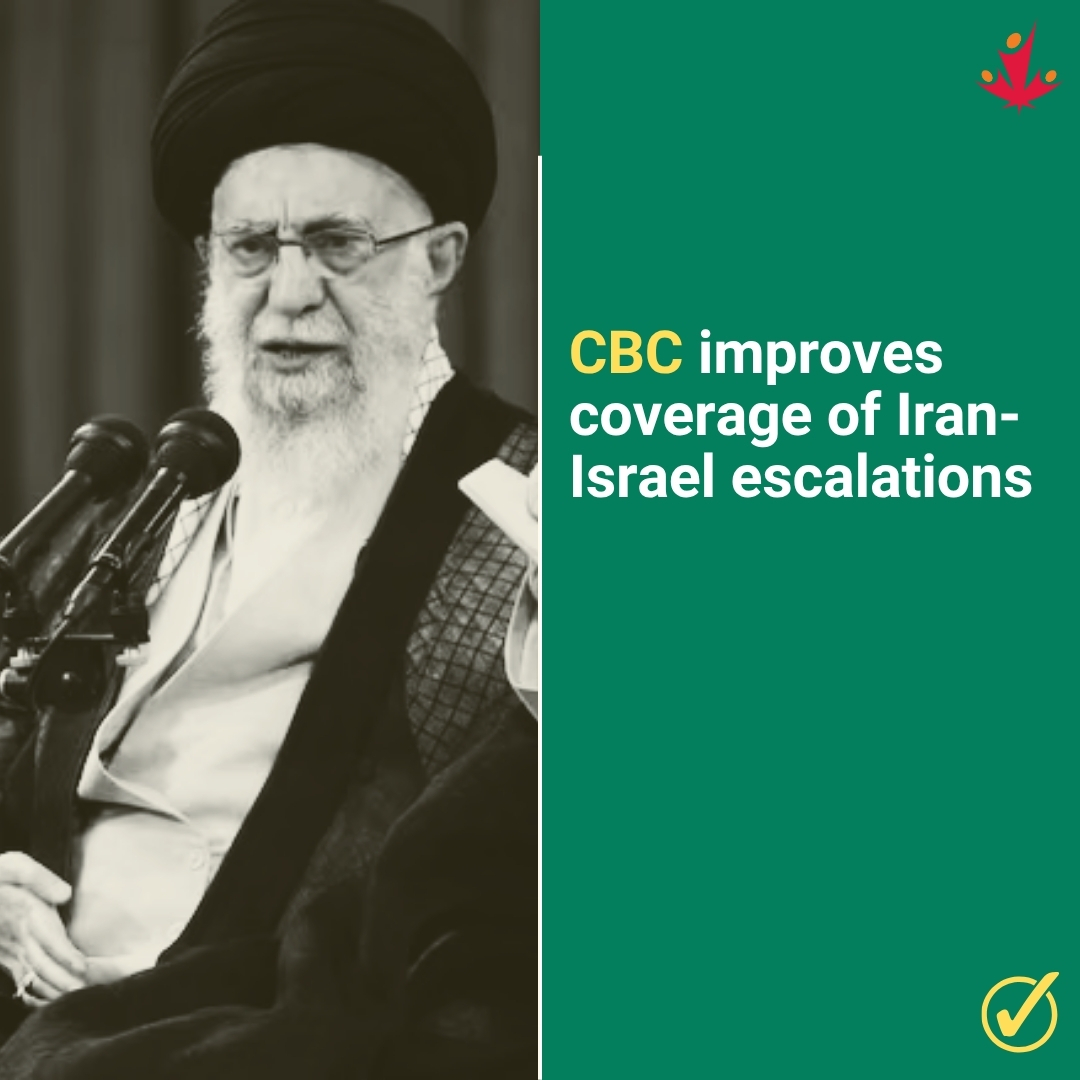 On June 13, 2025, CJPME Media Analyst Anthony Issa submitted a letter of concern to CBC about its coverage of Israel’s military attacks on Iranian nuclear facilities, which lacked essential legal and geopolitical context. The article uncritically presented Israel’s claim that Iran posed an imminent nuclear threat, while excluding perspectives from international watchdogs and experts skeptical of Israel’s accusations towards Iran.
In response, on June 19, CBC published a follow-up article titled “Israel says Iran is close to a nuclear weapon. Others doubt it” by Chris Brown. This article introduced significant clarifications that align with CJPME’s call for evidence-based reporting. Notably, it quoted the Arms Control Association, which stated: “There was no imminent threat that Iran was weaponizing its nuclear program before Israel's attack began.” The group warned that military action could backfire by pushing Iran to weaponize its nuclear program and escalate tensions into a regional war.
The article also emphasized that the International Atomic Energy Agency (IAEA) had not found credible evidence that Iran’s enriched uranium was being diverted for military use. Director Rafael Grossi explicitly stated, “We cannot say that we at the IAEA have enough credible elements which would be pointing directly at this.”
In a major step toward balanced reporting, the article also drew attention to Israel’s longstanding nuclear arsenal, its refusal to sign the Nuclear Non-Proliferation Treaty (NPT), its exemption from IAEA oversight, and raising critical questions of double standards over Israel's nuclear regime.
CJPME thanks the CBC and Chris Brown for following up on its coverage, This editorial shift reflects a deeper commitment to factual accuracy, transparency, and accountability in Canadian journalism.
Lack of legal context regarding Israel’s blockade & the Madleen Freedom Flotilla
"By failing to inform readers that the Madleen was intercepted in international waters — and that such an act violates multiple instruments of international law — your reporting presents Israel’s abhorrent actions as permissible, rather than as grave breaches of international humanitarian law that is supposedly designed to protect civilian vessels and humanitarian missions."
Read moreOmission of legal context regarding Israel’s unprovoked airstrikes on Iran
"By framing Israel’s aggression as the start of the conflict without this legal context, the article suggests a false moral equivalence between unlawful aggression and retaliation."
Read moreNo mention of Israel’s siege on Palestinians in Gaza
"Presented without context, the reporting suggests that the collapse of Gaza’s health care system is occurring in a vacuum. In reality, Israel has been imposing a genocidal siege on Palestinians in the occupied Gaza Strip for the past 100 days — intensifying a blockade that has been in place since 2008. The Israeli occupation forces have even calculated the minimum caloric intake required to prevent starvation, deliberately restricting aid and conditioning its entry as a form of collective punishment."
Read moreConcerns over reporting of Iran-Israel escalations
"I ask that the CBC revisit this story with a follow-up that identifies the illegality of attacking nuclear facilities under international law, acknowledges how these attacks disrupted active diplomatic negotiations, critically examines commentary from ideologically driven think tanks such as RUSI, and incorporates perspectives from nuclear non-proliferation experts whose analysis prioritizes diplomacy and de-escalation."
Read moreIsrael’s interception of Gaza’s Madleen flotilla violates IHL— CBC omits this imp legal context
"By failing to inform readers that the Madleen was intercepted in international waters — and that such an act violates multiple instruments of international law — your reporting presents Israel’s abhorrent actions as permissible, rather than as grave breaches of international humanitarian law that is supposedly designed to protect civilian vessels and humanitarian missions."
Read more