
"In light of the above, referring to it as “disputed” misleads readers and violates the journalistic imperative of accuracy. I urge you to revise the article in question and to adopt the terminology “occupied West Bank” in all future reporting on this issue. Using accurate language is essential to uphold the journalistic principles of accuracy, impartiality, and fairness expected from professional journalists."
 August 15, 2025
Dear CBC and Reuters editorial newsrooms,
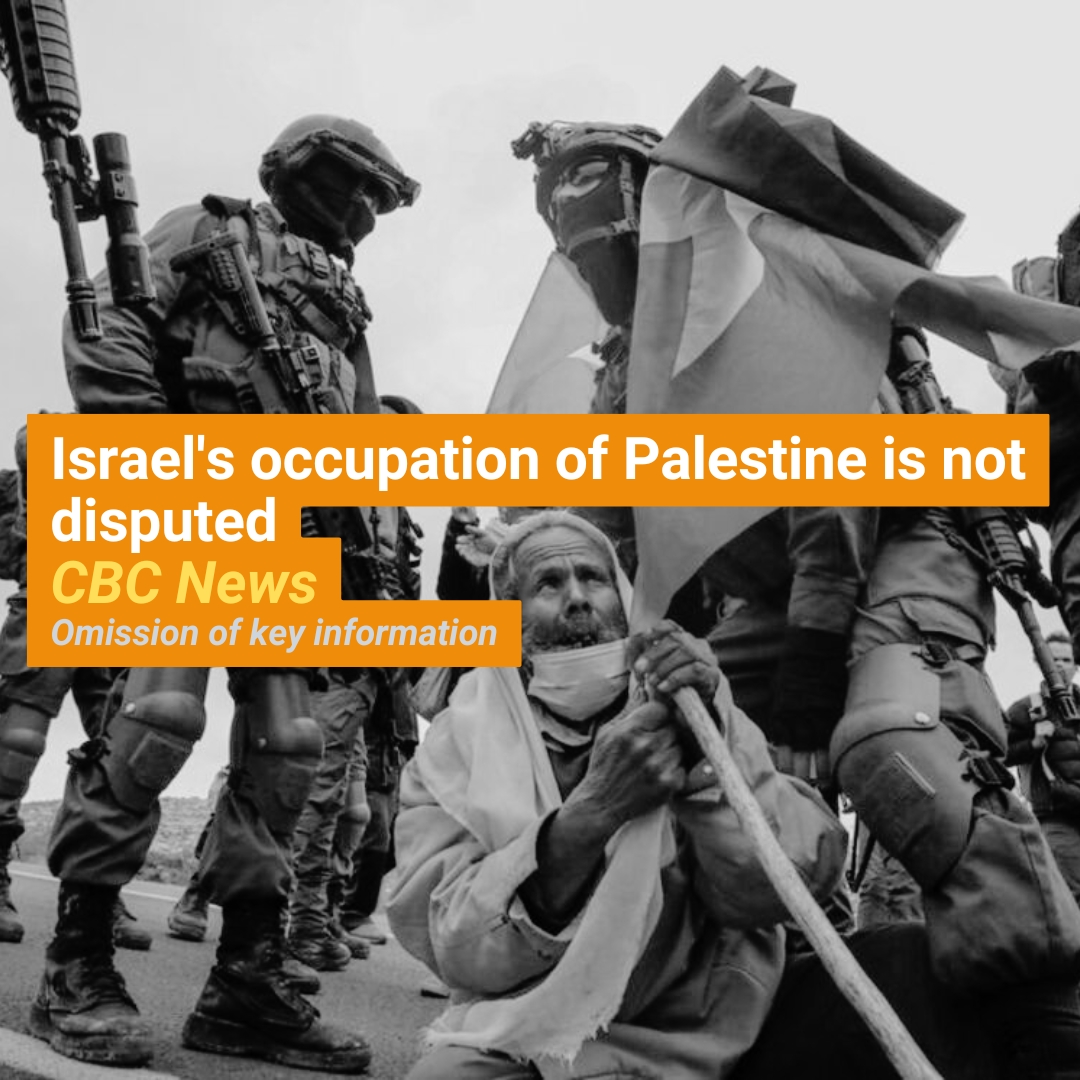
I am writing on behalf of Canadians for Justice and Peace in the Middle East to express my concern regarding your recent article titled “UN protests Israeli minister’s proposal of settlement to ‘bury’ idea of Palestinian state,” published onAug 14,2025.
At the end of the article, the West Bank is described as “disputed” territory, however this term is inaccurate and misleading for several reasons. I would advise your newsrooms to consult CJPME’s media accountability project essay on the term occupied when referring to the Palestinian territories. I will break down the reasons why captured is an inaccurate term when referring to Israel’s actions in the West Bank.
-
International law does not recognize the acquisition of territory by force. The United Nations Charter explicitly prohibits such actions, and numerous UN resolutions have reaffirmed that Israel's presence in these areas constitutes an occupation. As such, these territories are internationally recognized as occupied Palestinian territories (OPT), not as territories captured/disputed by Israel.
-
Terms like “captured” or |disputed" suggests a sense of permanence or legal legitimacy to Israel’s control, which is contrary to the principles of international law. In contrast, “occupied” reflects the ongoing military control of these areas, as consistently described by the International Court of Justice (ICJ) and the UN. Failing to use the correct term misleads readers and undermines the accuracy and integrity of your reporting.
-
Language plays a powerful role in shaping public understanding. Using “disputed” risks erasing the lived experiences of Palestinians and minimizes the illegality of the ongoing occupation. This framing also contradicts the terminology adopted by Canada, the United States, the UN, and human rights organizations, which uniformly describe these territories as occupied. For example, the ICJ ruled in 2004 that Israel's status in the West Bank, East Jerusalem, and Gaza is that of an occupying power. Similarly, the signatories of the Fourth Geneva Convention reaffirmed in 2001 that the Convention applies to the occupied Palestinian territories, explicitly identifying Israel as the occupying power. These consistent legal interpretations reinforce the necessity of using precise and accurate language in media reporting.
4. The term “disputed” not only misrepresents legal realities but also perpetuates the erasure of Palestinian rights. It implies that Palestinians have no legitimate claim to these territories, reinforcing a narrative that marginalizes their struggle for self-determination.
While the article notes that “most of the global community considers all settlements illegal under international law,” it omits the legal context explaining why all major international legal bodies conclude that Israel’s occupation is illegal. It also places Israel’s historical and biblical claims, as well as its stated security justifications for settlements, alongside the global consensus on their illegality. This “both sides” approach falsely equates an occupying power with the occupied population, obscures the asymmetrical power relationship, and conceals the fact that the settlements themselves serve as an instrument of colonization and dispossession. This is not a matter of opinion but of binding international law, and omitting this fact denies readers essential context.
In light of the above, referring to it as “disputed” misleads readers and violates the journalistic imperative of accuracy. I urge you to revise the article in question and to adopt the terminology “occupied West Bank” in all future reporting on this issue. Using accurate language is essential to uphold the journalistic principles of accuracy, impartiality, and fairness expected from professional journalists.
--