
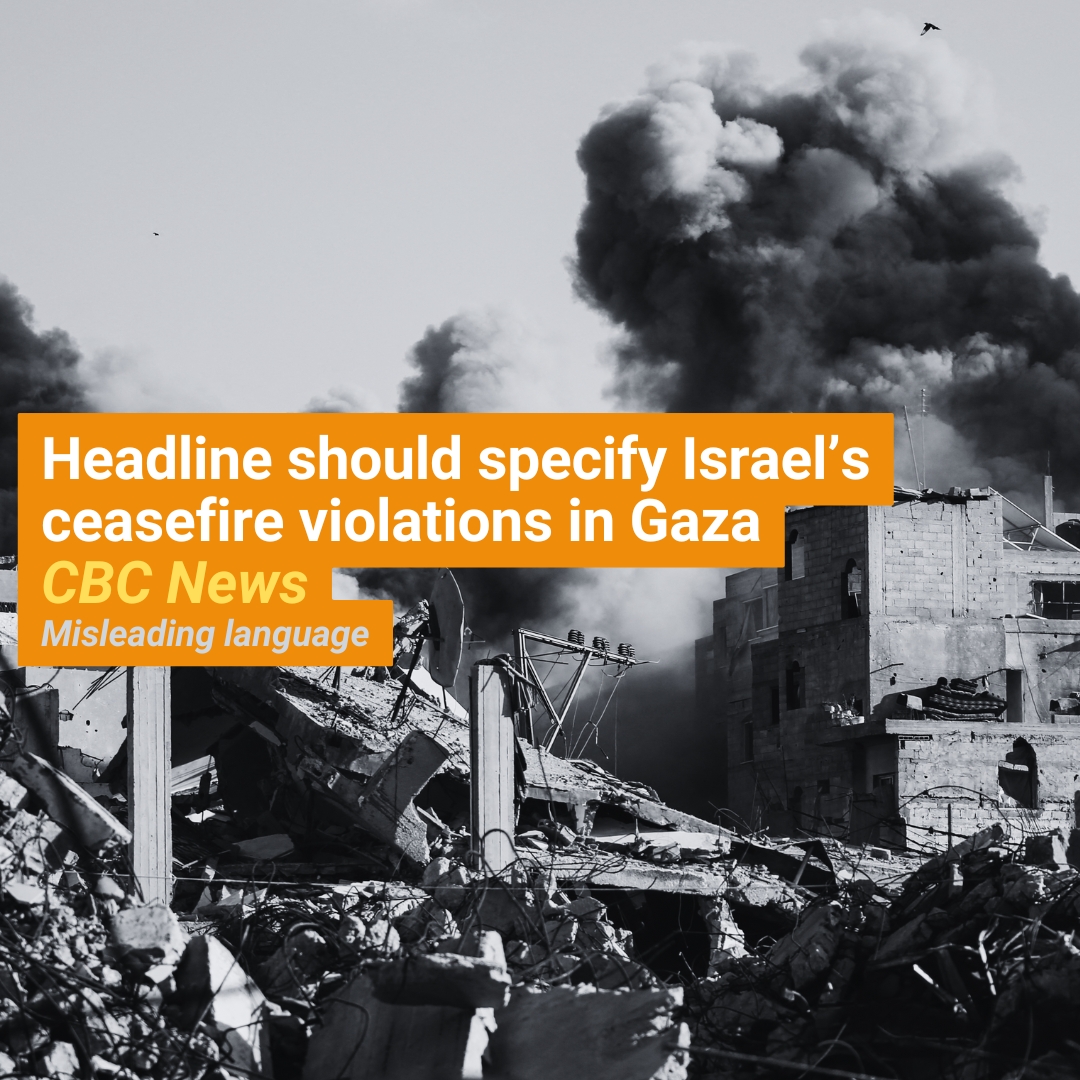
A ceasefire, as defined by Doctors Without Borders, is “an agreement that regulates the cessation of all military activity for a given length of time in a given area.” By definition, a ceasefire implies an end to violence. That is not the reality in Gaza.
 To the CBC News newsroom,
I am writing on behalf of Canadians for Justice and Peace in the Middle East (www.cjpme.org) regarding your article titled: “Trump's 'Board of Peace' proposal met with skepticism amid shaky Gaza ceasefire.”
I first want to raise concern regarding the headline’s reference to a “shaky ceasefire” in Gaza, which is misleading and inaccurate. A ceasefire, as defined by Doctors Without Borders, is “an agreement that regulates the cessation of all military activity for a given length of time in a given area.” By definition, a ceasefire implies an end to violence.
That is not the reality in Gaza.
What is described as a ceasefire in Gaza no longer meets the definition of the term. Israeli air and artillery attacks have continued across occupied Gaza, killing more than 460 Palestinians and wounding over 1,200 Palestinians since the ceasefire came into effect on October 10.
More troubling still, since October 2025 mainstream media language has increasingly relied on euphemisms that manufacture the appearance of a meaningful ceasefire where none exists.
In the interest of fair, accurate, and responsible journalism, the headline should explicitly identify Israel’s ongoing ceasefire violations.
We recommend revising the sentence to: “Trump’s ‘Board of Peace’ proposal met with skepticism, caution amid Israel’s ongoing violations of the Gaza ceasefire.”
Second, the article states that winter has not been “kind” to Gaza. While this is true, the framing avoids the more important question: why Palestinians in Gaza are exposed to these conditions in the first place.
Israel’s military campaign, which many human rights organizations and the International Court of Justice have concluded is genocidal, has forcibly displaced nearly the entire Palestinian population multiple times through repeated evacuation orders, as documented by the United Nations Office for the Coordination of Humanitarian Affairs.
Attributing this suffering to winter conditions is to erase Israel’s responsibility.
The article should clearly state that Palestinians in Gaza are exposed to extreme weather because of Israel’s genocidal violence and forced displacement.
In the name of accurate and fair reporting, we recommend the following revision:
Freezing rain has lashed the coast, and brisk Mediterranean winds have blown down tents that house many of Gaza’s population of close to two million homeless Palestinians due to Israel’s military campaign which many human rights organizations and the International Court of Justice have concluded is genocidal.
Thank you for reading and I look forward to your response.