
The aim of this essay is to examine the misleading use of the term “prisoner” to describe Palestinians who are illegally abducted by Israel and subjected to severe human rights abuses inside Israeli prisons.
 Introduction
During the first phase of the ceasefire deal between Israel and Hamas in January 2025, Israel agreed to release around 2,000 Palestinian political prisoners and detainees in exchange for approximately 30 Israeli hostages held in Gaza. A similar deal was agreed to in October 2025. In both cases, mainstream media overwhelmingly summarized the exchange in the following terms: Hamas would release Israeli “hostages,” while Israel would release Palestinian “prisoners.” Absent from most coverage was a crucial distinction: many of the Palestinians that were released are not prisoners in the conventional sense, but were effectively hostages, held for months or years without charge or fair trial under Israel’s administrative detention policy. Further, many Israelis held by Hamas and other groups in Gaza were not civilians, but soldiers on active duty who fit the criteria of “prisoners of war.[1]” Some outlets went even further, reporting solely on the hostages released by Hamas, while omitting that thousands of Palestinian political prisoners and detainees were being released as part of the same ceasefire deal.[2]
One notable exception was a CBC article[3] written by Chris Brown titled “Hostage, prisoner or detainee? In the latest Israel-Hamas exchange, it's not always clear.” Brown quoted Palestinian activist Bushra Al-Tahil (who was released in the January 2025 ceasefire deal despite never being convicted) who explained that Israel weaponizes the use of the word “terrorism” to illegally detain Palestinians and criminalize dissent. In her case, as Brown noted, her “crime” was posting online about resisting Israel’s illegal occupation. Yet despite this specific article that provided context about Israel’s illegal detention of Palestinians and what administrative detention is, most media coverage, including CBC’s, continues to blur the lines regarding the difference between “prisoner,” “hostage,” and “detainee.” The aim of this essay then is to examine the misleading use of the term “prisoner” to describe Palestinians who are illegally abducted by Israel and subjected to severe human rights abuses inside Israeli prisons.
Detainee vs prisoner
A prisoner is generally understood as someone who has been lawfully convicted of a criminal offense, following “a fair and public hearing by a competent, independent, and impartial tribunal”, and is serving a sentence of imprisonment as a result.[4] In other words, the term “prisoner” presupposes a lawful conviction and adherence to due process. Yet thousands of Palestinian men, women, minors, activists, journalists and doctors are held by Israel without charge or fair trial under Israel’s administrative detention policy. Referring to Palestinian detainees as “prisoners,” then, downplays the illegality of their detention and falsely implies guilt where none is legally established.
What is administrative detention?
In Israel and East Jerusalem, administrative detention orders are authorized by the Minister of Defence, whereas in the rest of the Occupied Palestinian Territories (excluding East Jerusalem), these orders are issued by military commanders. Israeli officials claim that this policy is used only when there is solid evidence that an individual poses a threat to state security or civilians, whether they are Arab or Jewish. In reality, however, the law’s broad and vague wording allows the Israeli occupation forces to weaponize it under the pretext of security, enabling the illegal detention of Palestinians as prisoners of conscience.
Practically speaking, administrative detention allows Israel to detain Palestinians for renewable periods of up to six months, based on secret evidence withheld from both the detainee and their lawyer.[5] If Israeli officials believe “reasonable grounds” exist, they are able to extend the original order for an additional six-month period “from time to time.”[6] There is no limit on the overall time that a person can be held in administrative detention, so the detention can be extended over and over. This means that Palestinians can spend months or even years in prison without ever knowing the accusations against them or having the chance to contest their detention in a fair trial. Even for Palestinians who do face trial, Israel’s military courts are inherently discriminatory with a 99% conviction rate.[7]
One such case is that of Ahmad Mansara, a Palestinian political prisoner from Beir Hanina in occupied Jerusalem. In 2015, at just thirteen years old, Mansara was arrested over alleged accusations that he was involved in a stabbing carried out by his cousin in Pisgat Ze’ev — an illegal settlement in Jerusalem. Although the evidence showed that he himself harmed no one, an Israeli military court convicted him of attempted murder and sentenced him to nine and a half years in prison. His confinement has been repeatedly extended, and since 2021, he spent 23 hours a day in solitary confinement. An external physician from Doctors Without Borders was eventually permitted to examine him and reported that Mansara suffered from schizophrenia, depression, paranoia, and severe insomnia — conditions that only worsened under prolonged isolation.[8] Despite this, the Be’er Sheva District Court repeatedly extended his solitary confinement based on “secret evidence” that neither Ahmad nor his lawyer were allowed to access. Ahmad was finally released on April 10, 2025. His case is one of many in which Israel systematically robs Palestinian children of their childhood, subjecting them to physical torture, psychological terror during interrogation, and humiliation.
Israel has also been detaining medical doctors. Dr. Mohammed Abu Selmia, director of Al-Shifa Hospital, was detained at a checkpoint by the Israeli occupation forces in November 2023 while escorting patients in an ambulance following an Israeli order to evacuate the hospital. During his detention, which lasted seven months without charge nor trial, he was subjected to inhumane torture over unproven allegations that the hospital served as a Hamas command center — accusations he and other health officials denied.[9] Dr. Abu Selmia described enduring vicious beatings, dog attacks, severe medical neglect, and deliberate starvation. As reported by The Guardian, he testified:[10]
“I am talking about clubbing, being beaten with rifle butts and being attacked by dogs. There was little to no food, no personal hygiene, no soap inside the cells, no water, no toilet, no toilet paper … I saw people who were dying there … I was beaten so badly I couldn’t use my legs or walk. No day passes without torture.”
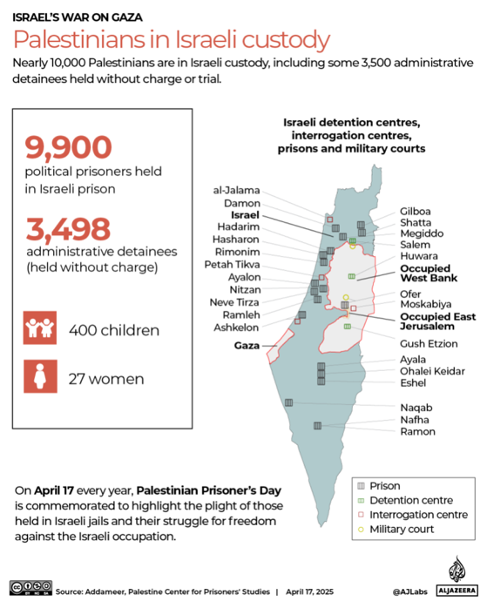
Similarly, Dr. Hussam Abu Safiya, Director of Kamal Adwan Hospital in northern Gaza, a pediatrician and neonatologist, was detained by Israel On 27 December 2024. His lawyer, Ghaid Ghanem Qassem, reported that Dr. Abu Safiya has lost nearly 40% of his body weight since his detention, dropping from 100 to 60 kilos, and has been subjected to torture, beatings, mistreatment, and a lack of proper medical care.[11] Nearly seven months into his detention — held not for any crime, but simply because he refused to abandon his patients — there is still no indication of when he might be released. Both doctors are among the thousands of Palestinians unfairly detained by the Israeli occupation forces since October 2023[12]:
Conclusion
When covering the Israeli-Palestinian exchange of hostages, mainstream media is omitting to mention what Israel's administrative policy is and the kinds of torture Palestinians endure in Israeli prisons. To meet basic journalistic standards of fairness and accuracy, CJPME urges journalists to clarify that many Palestinians are not convicted prisoners in the conventional sense, but effectively hostages held without charges, subjected to severe human rights abuses, and denied fair trials under Israel’s administrative detention policy.
[1] International Committee of the Red Cross. “Prisoners of War.” How Does Law Protect in War? Accessed October 15, 2025. https://casebook.icrc.org/a_to_z/glossary/prisoners-war
[2] CBC Toronto News Broadcast. February 21, 2025, 7:20 a.m.
[3] Chris Brown. “Hostage, Prisoner or Detainee? In the Latest Israel–Hamas Exchange, It’s Not Always Clear.” CBC News. April 14, 2025. Accessed July 4, 2025. https://www.cbc.ca/news/world/israel-hamas-hostage-prisoner-detainee-1.7438267.
[4] United Nations Office of the High Commissioner for Human Rights. "International Covenant on Civil and Political Rights." Article 14. December 16, 1966. Accessed July 23, 2025. https://www.ohchr.org/en/instruments-mechanisms/instruments/international-covenant-civil-and-political-rights
[5] Amnesty International Canada. “Israel Must End Mass Incommunicado Detention and Torture of Palestinians from Gaza.” July 18, 2024. Accessed June 27, 2025.
[6] B’Tselem. “Administrative Detention.” Accessed July 16, 2025. https://www.btselem.org/administrative_detention.
[7] Joel Gunter. “How Israel Jails Hundreds of Palestinians without Charge.” BBC News. December 15, 2023. Accessed October 15, 2025. https://www.bbc.com/news/world-middle-east-67600015.
[8] Al Jazeera. “Palestinian Ahmad Manasra Released from Israeli Prison after Nine Years.” April 10, 2025. Accessed July 18, 2025 https://www.aljazeera.com/news/2025/4/10/palestinian-ahmad-manasra-released-from-israeli-prison-after-nine-years.
[9] CBC News. “Israel orders Palestinians to flee Khan Younis, signaling possible return of troops.” July 1, 2024. Accessed July 18, 2025. https://www.cbc.ca/news/world/gaza-prisoner-exchange-shifa-hospital-director-released-1.7251433
[10] The Guardian. “More Than 160 Gazan Medics Held in Israeli Prisons amid Reports of Torture.” February 25, 2025. Accessed July 4, 2025. https://www.theguardian.com/global-development/2025/feb/25/more-than-160-gazan-medics-held-in-israeli-prisons-amid-reports-of-torture.
[11] Mohammad Sio. “Gaza Hospital Director Loses One-Third of His Weight in Israeli Detention: Report.” Anadolu Agency. July 15, 2025. Accessed July 16, 2025, http://aa.com.tr/en/middle-east/gaza-hospital-director-loses-one-third-of-his-weight-in-israeli-detention-report/3631823.
[12] Al Jazeera. “A Nation Behind Bars: Why Has Israel Imprisoned 10,000 Palestinians?.” April 17, 2025. Accessed July 4, 2025. https://www.aljazeera.com/news/2025/4/17/a-nation-behind-bars-why-has-israel-imprisoned-10000-palestinians.