
Treating the results as directly comparable is a polemic tactic designed to create a damaging narrative of guilt-by-association, which the Israeli government and its allies in the media have been using as an excuse to indiscriminately killing civilians en masse for almost two years.
 To the Globe and Mail Editors,
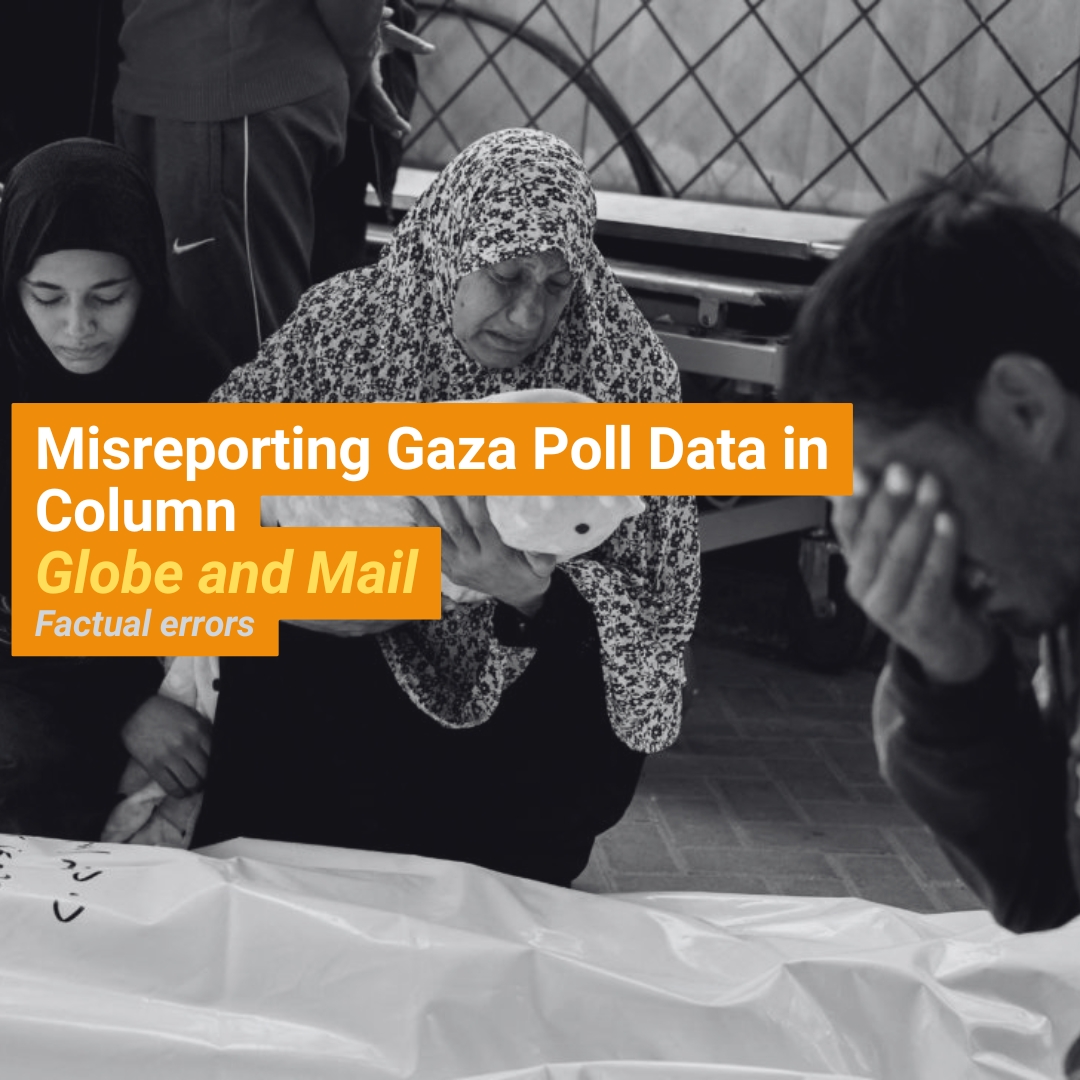
I am writing to demand changes to your recent article, “Qatar’s lesson: You don’t eliminate an enemy by bombing their path to retreat” (Thursday, September 11, 2025) that would help you to avoid misrepresentation, more accurately describe the full picture presented by the poll data to your readers and improve the credibility of your work.
Stating that in Gaza "two-thirds of the population disapprove" of Hamas is false and a clear misrepresentation or misunderstanding of the data (reported in the Guardian, linked to in the Globe’s piece), which actually says “support for Hamas tends to hover around the mid-30s in percentage terms”. This false dichotomy incorrectly presents a complex range of public opinion as a simple, two-choice question where you either approve or you disapprove. It is shocking that such a bombshell claim made it into a Globe and Mail article. This error deserves urgent correction.
In reality, public opinion is a spectrum that includes cohorts that have no opinion and others who range from mildly dissatisfied to enraged active opposition. Additionally, while a 35% approval rating is certainly not good, it is a common rating for a governing party during mid-term or difficult periods. Saying "two-thirds of the country disapprove" creates a powerful false narrative of overwhelming rejection of the party that simply is not true. To avoid misrepresentation, you should accurately describe the full picture presented by the poll data.
Additionally, using this framing to suggest that Palestinians in Gaza would not have mourned the death of fellow Palestinians, especially civilians trying to negotiate an urgently-needed ceasefire that could bring them food, medical aid and relief from the constant bombardment is absurd and offensive to anyone with a shred of decency and humanity.
The same article from the Guardian also sates that an unpublished survey conducted by the Ramallah-based Palestinian Center for Policy and Survey Research (PCPSR) before the ceasefire earlier this year “revealed an apparent decline in levels of support for Hamas, though it remains the most popular party in Gaza”. PCPSR has since carried out more polling about support for Hamas and, again, it totally contradicts the leading claim of this article.
However, the two surveys they are comparing measure entirely different concepts with vastly different thresholds for agreement: one based on general approval and the other on a specific question on support for “very extreme actions” to protect and defend Palestine. The phrasing implies actions that are outside the norm, potentially violent, illegal, or highly disruptive. Agreeing with this requires a much stronger, more ideological, and more committed stance.
Treating the results as directly comparable is a polemic tactic designed to create a damaging narrative of guilt-by-association, which the Israeli government and its allies in the media have been using as an excuse to indiscriminately killing civilians en masse for almost two years.
I cannot understate the importance of accuracy in political discourse. I demand that you correct the statement on Hamas’ approval rating in Gaza and amend your offensive and racist opening paragraph. Additionally, you should remove the link to the inflammatory and mis-leading article in the Guardian.
I await your action on these matters.
Nikki Mutch
Media Advocate
Canadians for Justice and Peace in the Middle East