
The Canadian Association of Journalists’ ethics guidelines state that “Any vested interest or potential bias on the part of a source” should be divulged. Nothing is said of potential bias of the unnamed source. What was their motivation? The authors do not ask this question in the article nor give an explanation. The examples given later in the article do not suggest there are any imminent threats to Canadian national security, therefore this aspect is unclear.
 To:
To:
Stewart Bell, Global News
Jeff Semple, Global News
James Armstrong, Global News
Amanda Connolly, Global News
Craig Offman, Global News
Nathen Sekhon, Global National
To the Global News and Global National editorial teams,
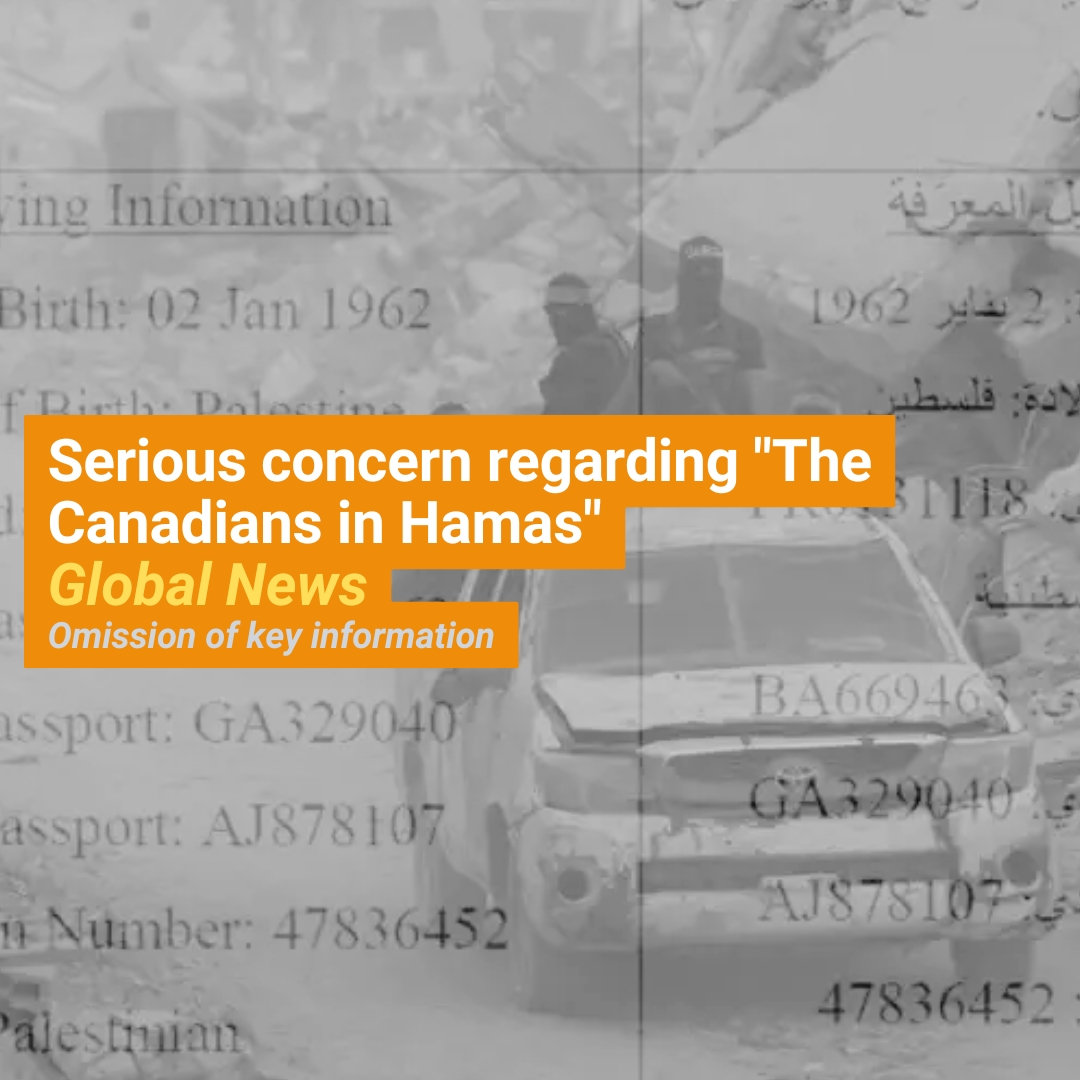
I am writing on behalf of Canadians for Justice and Peace in the Middle East (CJPME) to express serious concerns regarding several aspects of the article titled, “The Canadians in Hamas: The operative, leader and financier” by Stewart Bell and Jeff Semple. We are also concerned by the Global National broadcast version of the story by Jeff Semple. Given that the article has received significant public interest, we are especially troubled by the limited evidence and weak examples given for the piece’s core claims. Given the rising tide of anti-Palestinian racism in Canada, such bold allegations deserve far more care than given here.
450 number
The article relies on a single unnamed intelligence source for its central claim that:
About 450 people with assorted roles in Hamas have ties to Canada, according to a source familiar with the intelligence on the matter.
Despite how strongly the 450 number is presented and featured in the article, the number is unverifiable. CJPME believes that such a sensitive claim from Canada’s security apparatus should not be put forth so haphazardly and without meaningful verification. The claim lacks a clear evidentiary basis, inviting serious speculation.
The piece does mention that the source referenced a “list.” Was Global News able to view the list upon which the claim is based? If so, was Global able to independently verify its veracity in any meaningful way? Nothing is said to indicate the reader that Global did any due diligence in corroborating the list itself. If it was done, it should be clarified. If it wasn’t, the article deserves an editor’s note.
The Canadian Association of Journalists’ ethics guidelines state that “Any vested interest or potential bias on the part of a source” should be divulged. Nothing is said of potential bias of the unnamed source. What was their motivation? The authors do not ask this question in the article nor give an explanation. The examples given later in the article do not suggest there are any imminent threats to Canadian national security, therefore this aspect is unclear.
The initial claim is also vague (“assorted roles in Hamas”), but you elaborate, saying:
As Gaza’s de facto government, Hamas controlled a broad array of institutions for almost two decades, and many residents could have therefore had dealings with the group out of necessity.
The framing here is highly incomplete. Hamas has various wings, including military, media, politics, health and social services. Regardless of one’s opinion of Hamas, it won the elections in 2006 and is the governing authority in the occupied Gaza Strip. As such, the Palestinian Health Ministry in Gaza operates under its jurisdiction — as any civil institution would under a local government. Interaction with these institutions is therefore unavoidable for Palestinians in Gaza and is not evidence of political terrorist affiliation or support. Collapsing routine civic engagement into involvement in an armed “terrorist” group is a serious misrepresentation and not entirely true.
The article states that “the list was [allegedly] comprised of permanent residents, as well as those with family or associates in Canada.” Such a vague assertion would suggest that a Canadian relative of a doctor, journalist, or social worker in Gaza might all have “ties to Hamas.” The closeness of these relationships are also entirely unknown. Third cousins? Friends from elementary school? Such distant connections might fit such unclear criteria. Global News has provided its readers with not even a hint of an answer to any of these critical questions. Again, it is also not clear if Global relied solely on its unnamed source or if it was able to verify the claims of the source by assessing the list.
Global’s almost total reliance on pro-Israel perspectives — as well as those of U.S., Israeli, and Canadian intelligence sources and report — makes the above issues unsurprising. These are questions that would more likely have been raised if Global had interviewed more diverse sources, a basic journalistic expectation. In fact, a key commenter, Matthew Levitt, argues Hamas that Hamas providing essential social services is merely to maintain a “veil of legitimacy.”[1] Such a perspective seems implied in the article’s framing of Hamas and its functions within Gaza. To be clear, CJPME is not necessarily accusing the authors of bias, but we are noting that their reliance on biased sources appears to have significantly impacted their understanding and telling of this story to a troubling extent.
Two poor examples
In order to give substance to the leading claim of the piece, the article cites two examples. Both of them weaken the article — exposing the issues with the sensationalist assertions — rather than strengthening it.
What we learn from the profile on Usama Ali is ultimately very little. The authors were apparently unable to confirm if he is even alive, and give no details on his apparent life or ties in Canada beyond his alleged citizenship — the connection to Canada is summarized in the following terms: “details of Ali’s life in Canada are unclear.” It is believed he lives in Turkey. The allegations made by Global about Usama Ali all seem based on sanction information that is several years old.
It is stated as fact (but is actually based on Israeli and U.S. government allegations) that Mr. Ali is a member of the Shura Council. Membership of this body is almost always kept secret and Hamas has never acknowledged this claim to be true. As such, the claim deserves much clearer attribution than given. The article should specifically state, “According to unsubstantiated allegations by the U.S. and Israel, Ali became a member of the Shura Council.”
Next is Omar Alkassab. Similarly, the story we get is vague and unproven. All we learn is that he denies any involvement with Hamas, has not been found guilty of any crime, and allegedly had a cryptocurrency wallet based in Gaza, which the authors acknowledge could be used for “altruistic” or “humanitarian” purposes. His lawyer denied the claims against him and he emphasized how negatively this narrative has impacted his life.
The article takes the existence of a crypto wallet as inherently suspicious and as possible evidence of terrorism. This is bolstered by Global's repeating of Israel's allegation that the bombing of the building was related to terrorism. However, this ignores that getting currency in Gaza is extremely difficult due to Israeli restrictions. UN experts warned this year that “Israel has blocked the inflow of new currency, with severe cash scarcity driving drastic cost-of-living inflation and a decline in the value of wages.”[2] Inevitably, Israeli restrictions create the necessity for alternative currency options, like cryptocurrency.
As explained in Jewish Currents, the scarcity of cash has led to an embrace of cryptocurrency among Palestinian civilians.[3] Shops accept cryptocurrencies, as traditional banking infrastructure has almost totally collapsed. This is essential context that ought to be included for readers to consider.
Taken together, the two examples that are supposed to serve as evidence for these sensationalized claims are remarkably weak. Little is provided beyond unproven allegations and speculation. No credible “threat” can be said to be established by these examples. If anything, the claim that “450 people with assorted roles in Hamas have ties to Canada” seems even more dubious after assessing the examples given.
Millions or billions?
In the web article version of the piece, the authors claim that, according to the U.S. Treasury Department, the Hamas Investment office that Usama Ali was alleged to manage, had “an estimated US$500 million in assets, including construction and real estate companies.”[4] However, during your broadcast segment on the piece, the claim made by Jeff Semple is far greater:
Before launching its attack on Israel on October 7, Hamas had deep pockets. Billions of dollars of revenue and assets. According to U.S. officials, those investments were and are allegedly overseen by this man, Usama Ali, a Canadian.
This is a remarkable discrepancy that requires an on-air clarification or correction on Global National. To be clear, the broadcast specifies that Ali himself oversaw “billions,” when it refers to “those investments,” therefore Global cannot claim the billions was a reference to the broader holdings of Hamas. This discrepancy requires a clear clarification.
The piece and broadcast also fail to cite Hamas’s official denials of the U.S. Treasury claims. Reuters reported in May 2022 that Sami Abu Zuhri, a Hamas official, denied the US allegations.[5] Even if one doubts the denial, it is journalistically important to at least cite it.
Specific broadcast issues
During the broadcast segment, many of the same issues in the article are repeated, but some new issues are introduced. Semple refers to Hamas as a “terrorist group” without attribution. The claim ought to be attributed to meet basic journalistic standards. The language is used repeatedly throughout the broadcast without attribution. Canada does consider Hamas a terrorist group, along with some allies, but the vast majority of the world’s countries do not. These issues deserve an on-air clarification.
Semple also refers to “terrorist crypto accounts” in his discussion of Alkassab. This is alarming given that the article version explains that crypto accounts based in Gaza could have been held for “altruistic [or] humanitarian purposes.” That essential context is left out of the broadcast.
One-sided, single viewpoint reporting
Almost every key source in the article and broadcast, with the exception of professor Andreas Park (who appears to be a neutral expert in this context), is definitively or probably biased in favor of Israel.
- Matthew Levitt is a pro-Israel policy advocate.
- Hans Jakob-Schindler (broadcast) works for the Counter Extremism Project, which is closely affiliated and aligned with United Against Nuclear Iran (UANI). Both groups are highly critical of Iran and perceived allies, while promoting policies favorable to Israeli security interests.
- Noah Shack is the CEO of pro-Israel advocacy organization CIJA.
- Canadian, Israeli, and US government and military sources are heavily relied on.
As a result, the piece is extremely one-sided and unbalanced.
CIJA
Perhaps if Global News had interviewed organizations that aren’t veritable propaganda outfits for Israel, then any of our concerns might have been raised. Instead, Global interviewed the Centre for Israel and Jewish Affairs (CIJA), and their quote is spectacularly alarmist, and even has discriminatory undertones:
“The government of Canada must act urgently to confront the threat posed by Hamas-linked individuals, both to prevent attacks on Canadian soil and to ensure Canada is not exploited to facilitate terrorism abroad,” said Noah Shack, CEO of the Centre for Israel and Jewish Affairs.
“Participation in a banned terrorist group must bring real consequences. Canadians deserve to be protected from terrorist threats.”
CJPME believes that it is incredibly irresponsible to run a quote like this when Global appears not to have verified the alleged number of “Hamas-linked individuals,” or vetted the nature of those connections. The notion that Canada is dealing with “terrorist threats” or that any of the people on the alleged list have actually participated in so-called “terrorist” activities is unsubstantiated at best. Further, the reader is given no information about CIJA. It should be stated more clearly that CIJA is a major pro-Israel advocacy group in Canada. To publish such weak claims in such spectacular fashion, and allow partisan groups to dramatically exaggerate the evidence and implications without qualification, goes beyond shoddy journalism into the outright sphere of fearmongering.
CJPME is aware that there are efforts underway to curb immigration to Canada from Gaza, and there is ample evidence that the system in place to facilitate this is highly discriminatory, thus this article appears to fuel such prejudice — deliberately or not.[6]
Matthew Levitt and the Washington Institute for Near East Policy
While CIJA’s remarks were concerning, worse yet is the inclusion and qualification of comments by a so-called “leading expert on Hamas,” Matthew Levitt, a senior fellow at the Washington Institute for Near East Policy. Levitt is heavily featured in the piece and the broadcast version, and the framing by the journalists generally resembles Levitt’s positions. Despite the narrative importance of this source, we are told nothing about the organization he works for, the Washington Institute for Near East Policy (WINEP). Its ambiguous name may lead ordinary readers to believe it might even be relatively neutral. WINEP was founded with essential support from the American Israel Public Affairs Committee (AIPAC).[7] It is not a neutral think tank, but a pro-Israel organization seeking to shape policy. Noam Chomsky described WINEP as “an offshoot of the Israeli lobby,” a view that is widely held.[8] None of this is made clear by the article.
Further, Matthew Levvitt, again the article's “leading expert,” is widely panned as an unreliable researcher and policy partisan in numerous assessments of his book, which Global News refers to as evidence of his expertise.
Dr. Sara Roy — a senior research scholar at the Center for Middle Eastern Studies at Harvard University — said of Levitt’s book, “His evidence… is more often than not based on assumption, extrapolation and generalization.” She adds that his book “has many serious flaws… is not a work of analysis or scholarship, to say the least… anyone wishing to gain a substantive, reasoned and critical understanding of Hamas would do well to look elsewhere.”[9]
Pete W. Moore, a professor at Case Western University, writes that Levitt's research is “amateur,” “shoddy,” and “would end most graduate student careers.” Moore says his book is “useless in understanding Hamas or Palestinian politics.”
Khaled Hroub — a Palestinian academic, senior research fellow at the Centre of Islamic Studies and the co-ordinator of the Cambridge Arab Media Project at the University of Cambridge — described Levitt’s book as “sub-journalistic” and “war-mongering,” adding that information as elementary as the Israeli occupation itself is “completely absent in this work.”
The New York Times said of Levitt’s book that some readers will reasonably see it as “fronting for the Israeli intelligence establishment and its views,” because it “Levitt depends heavily on analyses from the Intelligence and Terrorism Information Center of the Center for Special Studies,” which is partly funded by the Israeli government.[10]
Even in a more favorable review by Glen Feder — a Senior Research Analyst at the Investigative Project on Terrorism, which has been described as a “leading source of anti-Muslim racism”[11] — the book is described not as a serious analysis of Hamas, but as a set of “policy prescriptions.”[12]
It bears repeating that this Global’s so-called “leading expert,” who is given wide latitude to frame the piece. CJPME believes that your reliance on Levitt and unqualified repetition of his partisan views is nothing short of journalistic malpractice. Global News must at least vet its sources, or give your viewers a fair and transparent sense of their interests and bias.
That the authors could not only rely on such an unreputable partisan figure, but describe him to Canadians as a “leading expert” calls into question their capacity to fairly report on this subject at all. While this piece perpetuates the villainization of Palestinians — deliberately or not — Stewart’s other work creates sympathetic narratives for Israelis. After years of regular observation and analysis, it is our view that Canadians relying on Global News for coverage of these issues are being exposed to a skewed perspective that unfairly disfavors Palestinians and often treats them as threats. CJPME is alarmed that the authors appear to be acting less as journalists in these articles than as willing scribes for the security states of Israel, Canada, and the U.S. as well as their non-governmental allies.
The response to the article
Despite the issues with this reporting, it has led to a viral frenzy supercharged by pro-Israel lobby groups in Canada. Such an irresponsible approach has led to fearmongering that is dangerous for Palestinians. Palestinians are already facing rising threats of violence and racism in Canada. They must now face even more scrutiny and skepticism because of Global’s irresponsible report. This month in Toronto alone we have seen a woman threaten a Palestine advocate with a corrosive chemical, an Israeli soldier beat up protesters, a man spray Palestine supporters with a “noxious substance” at a Palestine flag raising, and a woman drive through a sidewalk Palestine protest with a snow plow while flipping off demonstrators. These incidents should give journalists and newsrooms all the more reason to tread carefully when reporting on these sensitive issues, not issue highly partisan reports from completely one-sided perspectives that fuel anti-Palestinian narratives in Canada.
CIJA’s response is representative of others:
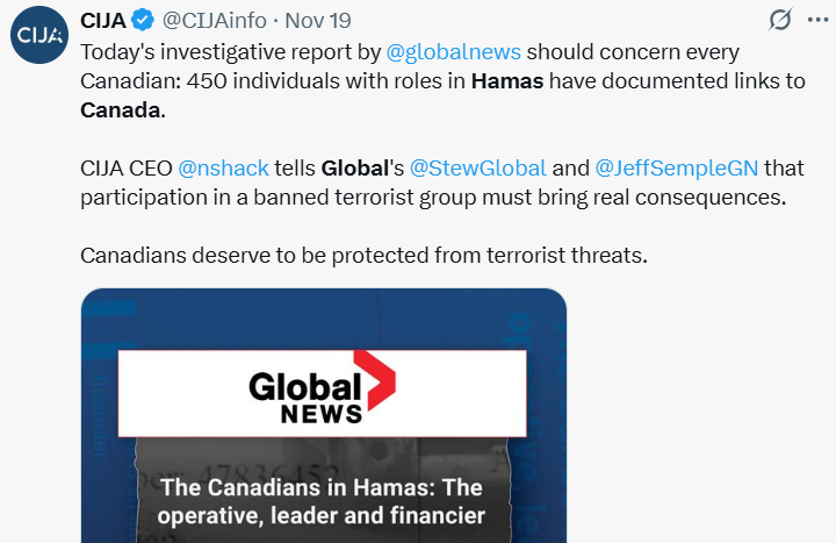
The notion that Canadians are facing “terrorist threats” from hundreds of individuals connected to Hamas is just not meaningfully established by this article. Such misrepresentations are commonplace because Global did not clearly enough qualify and temper its claims for readers. Global News is to blame for exaggerations and misleading claims like this one. Again, such narratives make Palestinian Canadians and their visible allies less safe.
Another example of this is a recent editorial from the Toronto Sun:
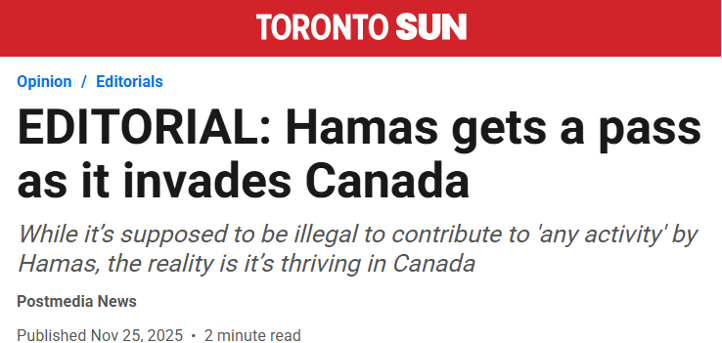
The Sun uses Global’s report as the basis of its alarmist claim that Canada is being “invaded” by Hamas. This is a clear and obvious demonstration of how and why Global’s article was irresponsible.
The authors do not clearly acknowledge the demonstrated limitations of the article, acting instead as if their piece is a rigorous bombshell. In fact, Stewart Bell shared a tweet from the Council for a Secure Canada that calls it a “bombshell.” It should concern us that Bell is seemingly endorsing this feedback, as the Council’s pro-Israel CEO recently claimed “Supporting Palestinian statehood means endorsing violence,” amongst other concerning statements.
Conclusion
In order to meet basic journalistic standards and ethics, and provide essential context, I request that Global News make the following corrections and clarifications to its article:
Clarify the evidentiary basis for the “450 people” claim
- Explain whether Global independently corroborated the list referenced by the unnamed intelligence official.
- Clarify what “ties,” “links,” or “assorted roles in Hamas” means in concrete, verifiable terms.
Clarify the nature of everyday interactions with Hamas-governed institutions
- Distinguish between involuntary, routine civic interactions with Gaza’s governing authorities and evidence of political or militant affiliation.
- Acknowledge that civil-service employees (health, media, policing, social services) are not automatically members of a terrorist or armed group.
Clarify attribution regarding Usama Ali’s alleged Shura Council membership
- Clearly attribute the claim to U.S. and Israeli government allegations, not as a stated fact.
- Note that Hamas has never publicly confirmed this and that membership is typically secret.
Contextualize and identify the biases of quoted sources
- Identify CIJA clearly as a pro-Israel advocacy organization.
- Identify the Washington Institute for Near East Policy as an AIPAC-aligned, pro-Israel policy institute.
- Acknowledge that the article’s perspective is overwhelmingly shaped by pro-Israel or Western security-aligned sources.
- Explain the highly controversial nature of Matthew Levitt’s work and its rejection by prominent academics.
Clarify the financial claim regarding the Hamas Investment Office
- Explain that the figure cited in the article (“US$500 million”) differs from the broadcast (“billions”), and state which is accurate.
- Add the official Hamas denial of the U.S. Treasury allegations, as reported by Reuters.
Attribute language labeling Hamas a “terrorist group”
- At the beginning of the article, attribute the designation on its first use rather than using the term as a Global News editorial assertion, only clarifying later.
Add essential context about Gaza’s financial restrictions
- Note that severe restrictions imposed by Israel have created currency shortages, contributing to the use of alternatives such as cryptocurrency.
Clarify that the examples provided (Ali and Alkassab) do not substantiate the central claim
- Add a clarification that the two profiled individuals do not demonstrate that “450” people with terrorist roles meaningfully “have ties to Canada,” and that the scope of the alleged risk remains unclear or unproven.
In order to meet basic journalistic standards and ethics, Global National should make the following on-air corrections and clarifications:
Correct the exaggerated financial claim
- Correct Jeff Semple’s statement that Hamas had “billions” in assets allegedly overseen by Ali and clarify that Global’s article reported “US$500 million,” not “billions.”
Add or correct attribution when calling Hamas a “terrorist group”
- Clarify on-air that this is the Canadian government’s designation, not an unqualified Global News editorial position.
Add missing context about cryptocurrency accounts
- Clarify that Global’s own article stated Gaza-based crypto wallets can be used for “altruistic” or “humanitarian” purposes, and that this context was omitted from the broadcast.
Clarify the uncertain and unverified nature of Usama Ali’s history in Canada
- The article does not mention that Ali’s history in Canada is “unclear.”
Disclose the affiliations and potential biases of broadcast “experts”
- Identify Hans Jakob-Schindler’s organization (Counter Extremism Project) and its affiliations.
- Identify Matthew Levitt and his organization (Washington Institute for Near East Policy) and its affiliations.
This article readily serves the interests of power and the security state, not of ordinary Canadians. In its “Journalistic Principles and Practices,” Global News promises “to investigate and hold power to account.” In this story, Global News doesn’t hold power to account — it makes an account of power.
Sincerely,
Jason Toney
Director of Media Advocacy, CJPME
[1] Matthew Levitt, Hamas: Politics, Charity, and Terrorism in the Service of Jihad (New Haven: Yale University Press, 2006).
[2] Office of the United Nations High Commissioner for Human Rights (OHCHR), “Israel’s Financial Stranglehold on the Occupied Palestinian Territory Must End: UN Experts,” press release, September 15, 2025, https://www.ohchr.org/en/press-releases/2025/09/israels-financial-stranglehold-occupied-palestinian-territory-must-end-un.
[3] Hani Qarmoot, “Cryptocurrency Comes to Gaza,” Jewish Currents, November 19, 2025, https://jewishcurrents.org/cryptocurrency-comes-to-gaza.
[4] U.S. Department of the Treasury, “Treasury Targets Covert Hamas Investment Network and Finance Official,” press release, May 24, 2022, https://home.treasury.gov/news/press-releases/jy0798.
[5] Reuters, “US sanctions Hamas official, finance network,” Al Jazeera, May 24, 2022, https://www.aljazeera.com/economy/2022/5/24/us-sanctions-hamas-official-finance-network.
[6] Canadians for Justice and Peace in the Middle East, “Canada’s Gaza Visa program designed to fail: CJPME report,” CJPME, September 23, 2024, https://www.cjpme.org/pr_2024_09_23_canada_gaza_visa.
[7] Thomas G. Mitchell (8 May 2013). Israel/Palestine and the Politics of a Two-State Solution. McFarland. pp. 164.
[8] Noam Chomsky, “Violence and Dignity: Reflections on the Middle East”, Chomsky.info, March 18, 2013, https://www.chomsky.info/20130318/.
[9] openDemocracy, “What is Hamas?” by Sara Roy, January 1, 2009, https://www.opendemocracy.net/en/what-is-hamas/.
[10] “A Review of Books: Hamas: Politics, Charity and Terrorism in the Service of Jihad,” The New York Times, June 25, 2006, https://www.nytimes.com/2006/06/25/books/review/25erlanger.html.
[11] Kumar, Deepa (2012). Islamophobia and the politics of empire. Chicago, Ill.: Haymarket Books. pp. 179–180.
[12] Glen Feder, “Debunking the Hamas Myth,” The Journal of International Security Affairs, no. 11 (Fall 2006), https://ciaotest.cc.columbia.edu/olj/jisa/jisa_2006_fall/jisa_2006_fall_w.pdf.