
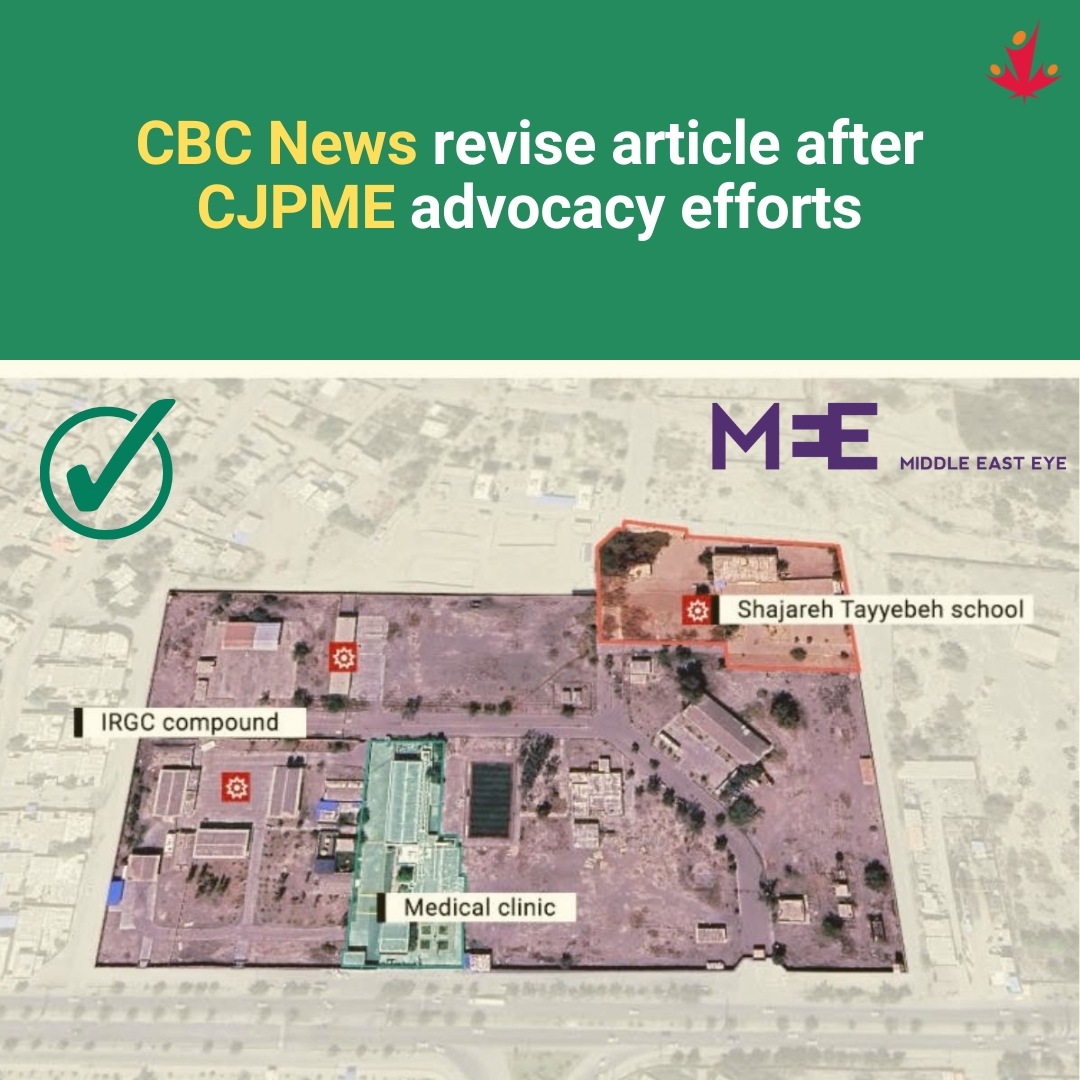
 On March 4, 2026, CBC News published an article titled “Who bombed a girls' school in Iran? A visual investigation.”
The piece was an investigation into the U.S. and Israeli bombing of an Iranian elementary school on Saturday, February 28, which killed 165 Iranian schoolgirls aged 7-12. The article stated that the school was struck by a “precision airstrike” targeting a military complex located immediately adjacent to the building. The article was unclear in explaining whether the strike on the school itself was deliberate or the result of faulty or outdated intelligence. Beyond just the CBC, Western media appeared in a rush to express skepticism about the massacre of schoolchildren, framing it as an accident, or suggesting the perpetrators were unknown. Even with the fog of war, the evidence in this case was obvious as soon as the dust settled.
Furthermore, the article misleadingly stated that “while the facility was functioning as a school, CBC News has confirmed a previous New York Times report stating the building was once part of an Islamic Revolutionary Guard Corps (IRGC) base.” In reality, the site has been a school since 2016, but CBC chose to omit a decades worth of essential context.
Following CJPME’s advocacy, the revised article now clarifies that both the school and the clinic within the complex had been walled off for civilian use for roughly a decade, information that had not been included in the original version of the article.
We also challenged the article’s claim that the school was likely struck due to a “precision airstrike” targeting the adjacent military complex. Al Jazeera’s Digital Investigations Unit analyzed two videos uploaded to Telegram shortly after the bombing and geolocated them using visible landmarks and satellite imagery.
The first video, filmed southwest of the complex, shows smoke rising from inside the Sayyid al-Shuhada military base (Asif Brigade), confirming that the military base itself was struck.
The second video, filmed from the southeast of the complex, shows two distinct columns of dense black smoke rising simultaneously, one from within the military base and another from the geographically separate location of the girls’ school.
The visible distance between the two smoke columns corresponds with the separation of the two sites in satellite imagery. Based on this evidence, Al Jazeera’s investigation concluded that the school was not damaged by debris or shrapnel from the adjacent base, but was instead struck separately. Other investigators have reached the same conclusion.
Following CJPME’s advocacy, CBC incorporated additional expert analysis from Wes Bryant, a U.S.-based military analyst and munitions expert, who stated that the available evidence suggests the strike on the school was not accidental, concluding that “this absolutely was deliberately targeted.”